Manufacturer vs Trader for Hotel Amenities: Which Is Right for Your Hotel?
Meta Description: Manufacturer vs trader for hotel amenities: understand the advantages of both, compare quality, pricing, customization, availability,
and supply, and learn how hotels can choose the right supplier.
When a hotel purchases guest amenities, the decision often starts with one question:
“Who is offering the best price?”
But hotel procurement is rarely that simple.
A hotel may need hundreds or thousands of products every month, including hotel slippers, dental kits, shaving kits, soaps, shampoo, shower gel, moisturizers, vanity kits, tissues, laundry bags and other guest-room supplies. The supplier behind these products can directly affect product quality, delivery schedules, customization, procurement effort and the overall guest experience.
This is where the manufacturer vs trader for hotel amenities debate becomes important.
A manufacturer and a trader can both supply hotels successfully. However, they operate differently, and each model has its own advantages.
The right choice depends on your hotel’s size, budget, order quantity, customization requirements, urgency and long-term procurement strategy.
Manufacturer vs Trader: What Is the Difference?
Before choosing a supplier, it is important to understand what these two business models actually mean.
What Is a Hotel Amenities Manufacturer?
A hotel amenities manufacturer produces some or all of the products it supplies.
Depending on the company and product category, manufacturing may include activities such as:
- Raw material sourcing
- Product formulation
- Cutting and stitching
- Assembly
- Printing and packaging
- Quality inspection
- Product customization
- Private-label production
- Bulk production
- Final packing and dispatch
For example, a manufacturer producing hotel slippers may control the material, sole thickness, fabric, stitching, finishing, packaging and production quantity.
Similarly, a toiletries manufacturer may manage the formulation, bottle selection, filling, labeling, packaging and batch production.
What Is a Hotel Amenities Trader?
A trader generally purchases products from manufacturers or other suppliers and then sells those products to hotels.
A trader may work with several manufacturers and brands.
This can allow the trader to offer a wider product range without manufacturing every item themselves.
For example, one trader may source:
- Hotel slippers from one factory
- Dental kits from another
- Soap from another manufacturer
- Shampoo from another supplier
- Tissue products from another company
The trader then coordinates these products for the hotel.
This model can be very useful when a hotel wants to purchase many different products from one contact.
The Advantages of Buying From a Manufacturer
A direct relationship with a manufacturer can offer several advantages, especially when the hotel has regular or bulk requirements.
1. Better Control Over Product Quality
One of the biggest advantages of working directly with a manufacturer is greater visibility into production.
The manufacturer can control or influence:
- Raw materials
- Production specifications
- Product dimensions
- Packaging
- Finishing
- Batch consistency
- Quality checks
For hotels, consistency matters.
Imagine ordering 5,000 pairs of hotel slippers and receiving a product that looks different from the approved sample.
That can create unnecessary problems for housekeeping and procurement teams.
A manufacturer can often create a defined production specification and repeat it for future orders.
2. Greater Customization
Customization is one of the strongest reasons hotels choose manufacturers.
A hotel may want:
- Custom logo
- Custom packaging
- Custom label
- Custom colors
- Custom sizes
- Custom materials
- Custom fragrance
- Custom product combinations
- Private-label production
For example, a hotel could develop its own branded:
Shampoo + Conditioner + Shower Gel + Body Lotion
set instead of using a generic product.
The same principle can apply to hotel slippers, dental kits, shaving kits, laundry bags and other guest amenities.
Manufacturers are generally better positioned to manage these production changes because customization can be built into the manufacturing process.
3. Better for Large and Repeat Orders
Manufacturing becomes particularly useful when a hotel has predictable demand.
For example:
100-room hotel × 30 days = 3,000 room nights per month
If the hotel provides certain amenities to every occupied room, its monthly consumption can quickly become significant.
For a hotel group with multiple properties, the requirement becomes even larger.
In such situations, a direct manufacturing relationship can make sense because the hotel can plan:
- Monthly quantities
- Production schedules
- Packaging requirements
- Reorder levels
- Delivery schedules
- Product specifications
This can create a more structured procurement system.
4. Private Label Hotel Amenities
Private labeling allows hotels and hospitality brands to put their own identity on products.
For example:
“ABC Hotels”
could have its own branded:
- Hotel shampoo
- Hotel soap
- Shower gel
- Body lotion
- Dental kit
- Shaving kit
- Hotel slippers
Instead of simply purchasing a standard product, the hotel can create a more consistent brand experience.
This is particularly useful for boutique hotels, resorts, hotel groups and properties that want their guest amenities to reflect their brand identity.
5. Better Production Planning
A manufacturer can plan production around confirmed orders.
This can be particularly useful for:
- Hotel openings
- Renovation projects
- Seasonal demand
- Large events
- Hotel chains
- Bulk procurement
- Regular monthly requirements
Instead of purchasing whatever is available at the moment, the hotel can work with a defined production and delivery plan.
The Advantages of Buying From a Trader
Choosing a trader does not automatically mean choosing a poor supplier.
In fact, traders can provide some important advantages.
1. Wider Product Variety
A trader may work with multiple manufacturers.
That can give the hotel access to a broad range of products through one supplier.
For example, a hotel may need:
- Slippers
- Dental kits
- Shaving kits
- Shower caps
- Soaps
- Shampoo
- Tissues
- Laundry bags
- Vanity kits
- Housekeeping supplies
Instead of contacting ten different manufacturers, the hotel may be able to coordinate these requirements through one trading company.
That can save considerable procurement time.
2. Flexible Sourcing
Because traders source from multiple manufacturers, they may be able to find alternative products when one supplier is unavailable.
This can be helpful when:
- A product is temporarily out of stock
- The hotel needs an urgent replacement
- A particular brand is unavailable
- The hotel wants several product categories together
- The required quantity is small
For hotels with mixed requirements, this flexibility can be valuable.
3. Convenient for Smaller Orders
Not every hotel wants to place large manufacturing orders.
A small boutique property may need relatively modest quantities.
A trader can sometimes provide products in smaller quantities because they are sourcing from existing stock rather than starting a dedicated production run.
This can reduce the need for large minimum order quantities in some situations.
4. Faster Availability
If the required product is already available in stock, a trader may be able to supply it quickly.
This can be useful when a hotel suddenly needs:
- Emergency stock
- Replacement products
- Additional slippers
- Additional dental kits
- Last-minute guest amenities
For urgent requirements, availability can sometimes be more important than customization.
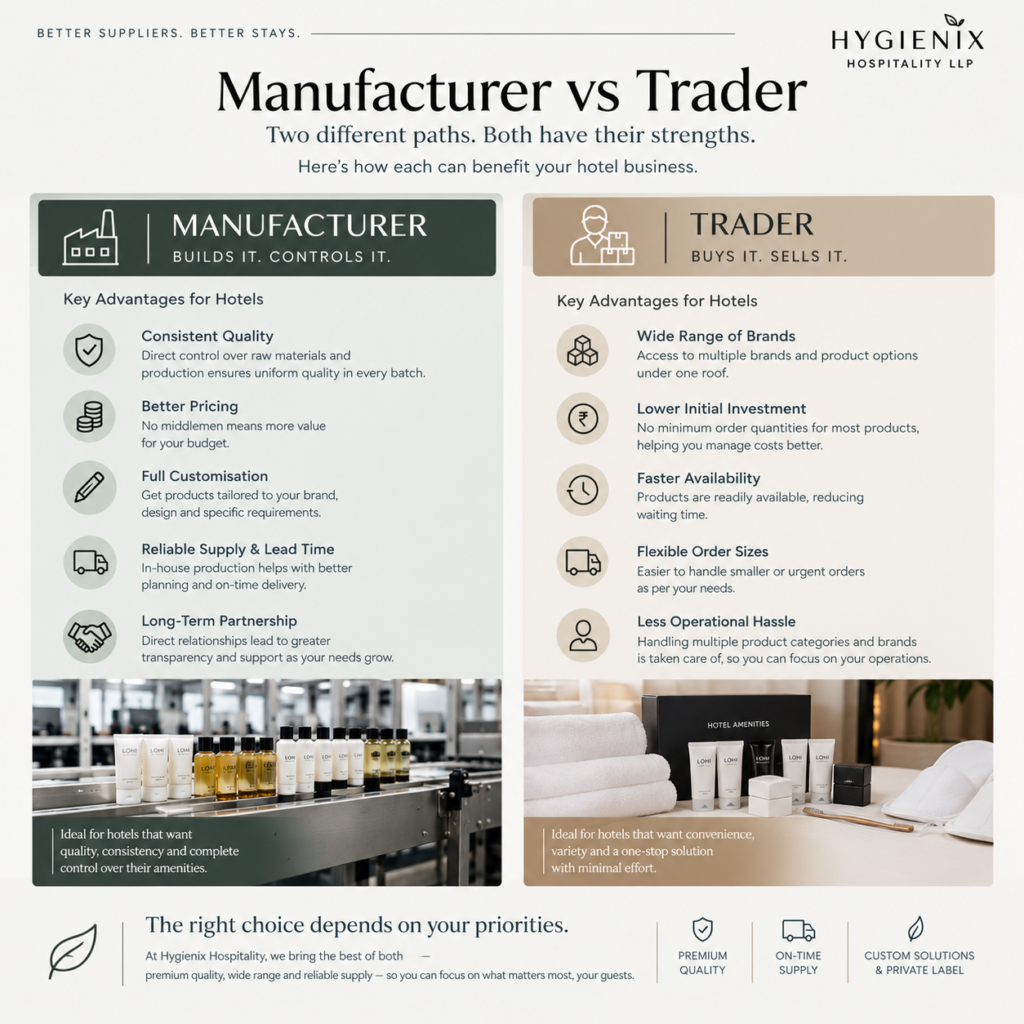
Manufacturer vs Trader: A Practical Comparison
| Factor | Manufacturer | Trader |
|---|---|---|
| Product manufacturing | Direct | Usually sourced |
| Quality control | Greater production control | Depends on manufacturing partners |
| Customization | Usually stronger | Depends on supplier network |
| Private labeling | Strong option | Possible through manufacturing partners |
| Product variety | May focus on selected categories | Often very broad |
| Small quantities | May have MOQ | Often more flexible |
| Bulk orders | Excellent | Can coordinate bulk supply |
| Urgent stock | Depends on production schedule | Can be faster if stock is available |
| Pricing | Can be competitive for bulk orders | Depends on sourcing and margins |
| Supplier consolidation | Possible | Often a major advantage |
| Long-term production planning | Strong | Depends on manufacturing partners |
| Best suited for | Bulk, repeat, custom requirements | Variety, convenience, mixed requirements |
The important point is that neither model is automatically better for every hotel.
The better question is:
Which supplier model matches your hotel’s actual requirements?
So, How Should a Hotel Choose?
Instead of asking only:
“Manufacturer or trader?”
hotel procurement teams should ask five bigger questions.
1. How Much Do You Buy?
If your hotel regularly purchases thousands of units, direct manufacturing may offer significant advantages.
For example:
- 5,000 hotel slippers
- 10,000 dental kits
- 5,000 shampoo bottles
- 5,000 soaps
At this scale, production planning and customization become more important.
However, if you only need a few hundred mixed products, a trader may offer greater flexibility.
2. Do You Need Customization?
If customization is important, ask:
“Can you manufacture this according to our specifications?”
Do not simply ask whether the supplier can put your logo on the product.
Ask about:
- MOQ
- Artwork approval
- Packaging
- Product specifications
- Sample approval
- Production timeline
- Repeat-order consistency
For a hotel looking for private-label hotel amenities, these details matter.
3. How Important Is Product Consistency?
A hotel should compare more than the first sample.
Ask:
“Will my next order look and feel the same?”
This is particularly important for high-volume products.
A good procurement process should compare:
- First sample
- Bulk production
- Packaging
- Material
- Dimensions
- Color
- Finish
- Performance
The goal is not simply to receive a good sample.
The goal is to receive consistent products repeatedly.
4. How Important Is Speed?
If you are opening a new hotel, renovating rooms or preparing for a high-season period, delivery becomes critical.
Ask your supplier:
- What is the standard lead time?
- What is the production capacity?
- What happens if demand increases?
- Can you support repeat orders?
- How quickly can you replenish stock?
- Where will the products be dispatched from?
A low price is not useful if the products arrive after the hotel needs them.
5. What Is the Real Cost?
The cheapest quotation is not always the cheapest procurement decision.
Hotels should consider the complete cost, including:
Product + Packaging + Freight + Handling + Defects + Replacement + Storage + Procurement Time
For example, suppose Supplier A offers a cheaper hotel slipper.
But the product has:
- More defects
- Poor packaging
- Inconsistent sizing
- Shorter usable life
The initial saving may disappear quickly.
This is why hotels should compare value, not just unit price.
A Simple Hotel Supplier Evaluation Scorecard
Hotels can use a simple scoring system when comparing suppliers.
| Criteria | Suggested Weight | Product Quality | 25% | Price / Total Cost | 20% | Supply Reliability | 15% | Customization | 10% | Lead Time | 10% | Product Range | 10% | Communication & Support | 5% | Packaging & Presentation | 5% |
|---|
The exact weights can change depending on the hotel.
For a luxury resort, customization and presentation may receive greater importance.
For a budget hotel, price and supply continuity may matter more.
For a new hotel opening, lead time and production capacity can become critical.
Questions Every Hotel Should Ask a Supplier
Before placing a large order, ask:
About the product
- What material is used?
- What are the exact specifications?
- Can you provide samples?
- Can the product be customized?
- Can the same specification be repeated in future orders?
About manufacturing
- Are you the manufacturer or a trader?
- Which products do you manufacture directly?
- Where is the production facility?
- What is your production capacity?
- How do you control quality?
About orders
- What is your MOQ?
- What is your standard lead time?
- Can you handle repeat bulk orders?
- What happens if the quantity increases?
- How do you manage urgent requirements?
About customization
- Can you provide private labeling?
- Can you customize packaging?
- What is the MOQ for custom branding?
- How long does artwork approval take?
- Can you provide a pre-production sample?
These questions can help a hotel move from simply comparing quotations to properly evaluating suppliers.
What About an All-in-One Hotel Supplier?
There is another model worth considering.
A hotel does not necessarily have to choose a pure manufacturer or a pure trader for every category.
An all-in-one hotel amenities supplier can combine manufacturing capabilities with sourcing and supply coordination.
This can be particularly useful when a hotel needs multiple categories from one procurement partner.
For example, a supplier may provide:
Guest Room Amenities
- Hotel slippers
- Dental kits
- Shaving kits
- Vanity kits
- Shower caps
- Laundry bags
Hotel Toiletries
- Hotel soap
- Shampoo
- Conditioner
- Shower gel
- Body lotion
- Bath salts
Paper Products
- Facial tissues
- Napkins
- M-fold towels
- Kitchen towels
Housekeeping Supplies
- Cleaning chemicals
- Housekeeping caddies
- Buckets
- Trolleys
- Dispensers
This approach can reduce the number of vendors a hotel has to manage.
Manufacturer vs Trader: The Right Choice Depends on Your Hotel
There is no universal winner.
A manufacturer may be the better choice when you need:
- Large quantities
- Consistent quality
- Custom specifications
- Private labeling
- Custom packaging
- Long-term production
- Regular repeat orders
A trader may be the better choice when you need:
- Multiple brands
- Wide product variety
- Smaller quantities
- Quick availability
- Flexible sourcing
- One supplier for many mixed products
And sometimes, the best solution is a supplier that can provide both manufacturing capability and sourcing flexibility.
Why This Matters for Hotel Amenities
Hotel amenities may look like small products.
A shampoo bottle may be small.
A dental kit may cost only a few rupees.
A pair of hotel slippers may be inexpensive.
But multiply those products by:
100 rooms × 30 days × 12 months
and procurement becomes a significant operational function.
That is why choosing the right hotel amenities supplier is not simply about getting the lowest quotation.
It is about finding a partner that can consistently deliver:
Quality + Value + Availability + Customization + Reliability
How Hygienix Hospitality Approaches Hotel Supply
At Hygienix Hospitality, our goal is to make hotel procurement simpler.
We work with hospitality businesses looking for reliable hotel amenities, guest-room products and customized solutions.
Our product categories include:
- Hotel slippers
- Dental kits
- Shaving kits
- Vanity kits
- Hotel soaps
- Shampoo
- Shower gel
- Moisturizers
- Eco-friendly hotel amenities
- Laundry bags
- Tissue and paper products
- Housekeeping supplies
For hotels that require customized products, we can also support private-label and custom-branded hotel amenities, depending on the product and quantity.
The goal is simple:
You focus on your guests. We help you manage your supplies.
Final Thoughts
The manufacturer vs trader for hotel amenities question should not be treated as a simple competition between two business models.
Both have advantages.
Manufacturers can offer greater control, customization and production planning.
Traders can offer variety, sourcing flexibility and convenience.
The right choice depends on what your hotel actually needs.
Before placing your next order, look beyond the price.
Ask about quality.
Ask about consistency.
Ask about MOQ.
Ask about customization.
Ask about lead time.
Ask about production capacity.
Ask about supply continuity.
And most importantly, ask:
“Can this supplier support my hotel not just for one order, but for the long term?”
Because in hospitality procurement, the best supplier is not always the one offering the lowest price.
It is the one that gives your hotel the right balance of quality, value, reliability and service.
Frequently Asked Questions
Is a manufacturer better than a trader for hotel amenities?
Not always. A manufacturer can be better for bulk orders, customization and private labeling, while a trader can be useful for product variety, smaller orders and quick availability.
What is the advantage of buying hotel amenities directly from a manufacturer?
Direct manufacturer relationships can provide better production visibility, customization options, consistent specifications and stronger support for bulk or repeat orders.
Can traders provide customized hotel amenities?
Yes. Some traders work with manufacturing partners who can provide custom branding and private-label products. Hotels should confirm the actual manufacturer, MOQ, sample process and production timeline.
Should small hotels buy from a manufacturer or trader?
A small hotel should compare MOQ, price, product availability and flexibility. If the hotel needs small quantities of many different products, a trader may be convenient. If it needs customized or regularly replenished products, a manufacturer may be more suitable.
What should hotels consider when choosing a hotel amenities supplier?
Hotels should evaluate product quality, pricing, MOQ, customization, lead time, supply capacity, packaging, communication, consistency and after-sales support.
What are private-label hotel amenities?
Private-label hotel amenities are products manufactured or supplied specifically under a hotel’s own brand name, packaging or specifications.
Can one supplier provide all hotel amenities?
Some hospitality suppliers can coordinate multiple categories, including hotel slippers, toiletries, dental kits, shaving kits, tissues, laundry bags and housekeeping supplies. Hotels should check the supplier’s actual manufacturing and sourcing capabilities before consolidating their procurement.