
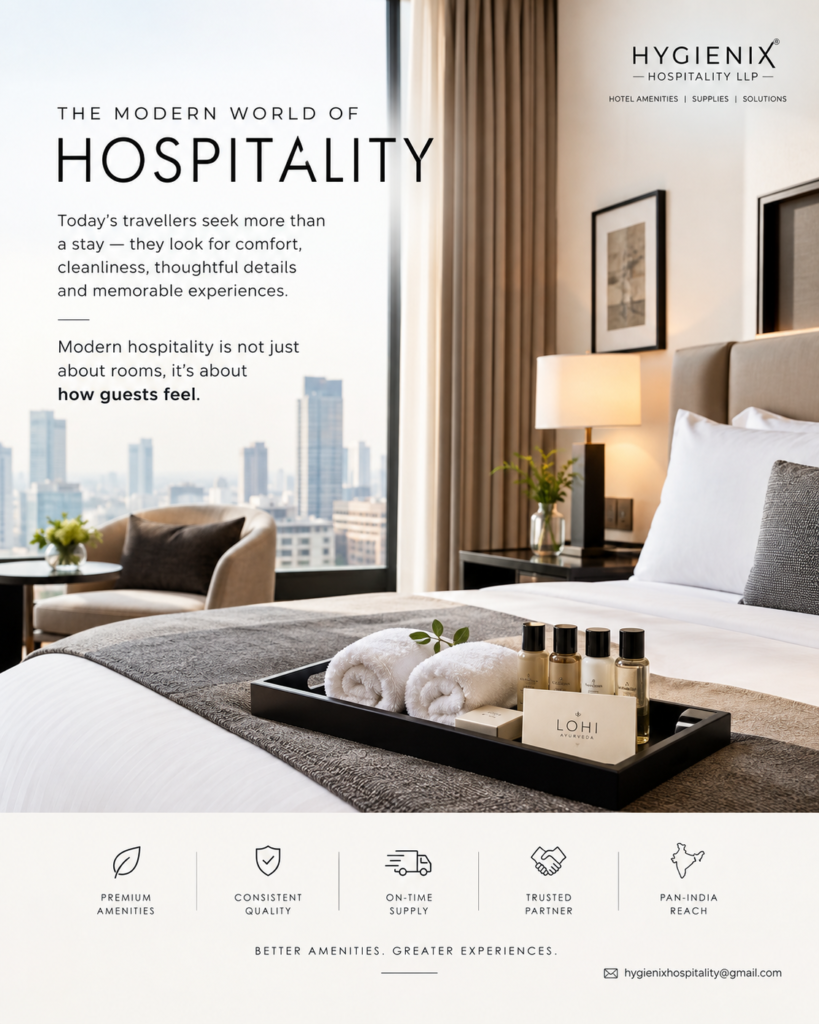

Modern World Hospitality: The Future of Hotel Guest Experience
The modern world hospitality industry is changing faster than ever. Today, guests expect more than a clean room and a comfortable bed. They want convenience, thoughtful service, quality amenities, personalized experiences, and a stay that feels easy from check-in to check-out.
At the same time, hotels and resorts face their own challenges. Rising operating costs, changing guest expectations, staffing pressures, sustainability requirements, and new technology are reshaping the way properties operate.
Therefore, modern hospitality is no longer simply about providing accommodation. It is about creating a complete guest experience while keeping hotel operations efficient, reliable, and consistent.
From hotel toiletries and bathroom slippers to digital services, housekeeping supplies, personalized experiences, and sustainable products, every detail can contribute to how guests remember a property.
What Is Modern World Hospitality?
Modern world hospitality means creating a seamless, comfortable, personalized, and efficient guest experience by combining quality service, thoughtful amenities, technology, sustainability, and human connection.
In simple terms, modern hospitality is about understanding what guests need and delivering it at the right time.
A modern hotel does not necessarily need the most expensive technology or the largest number of facilities. Instead, it needs to remove unnecessary friction from the guest journey.
For example, guests increasingly value convenient digital services, personalized communication, cleanliness, comfortable rooms, useful amenities, and responsive service.
Technology can support these expectations, but it should not replace genuine hospitality. Research from Oracle Hospitality and Skift found strong consumer interest in digital and personalized hotel experiences, while also emphasizing that technology should improve the overall guest journey.
Why Modern World Hospitality Is Changing
Guest expectations have changed significantly.
Travelers today compare their hotel experience not only with other hotels but also with the convenience they experience in other parts of their lives.
They are accustomed to fast communication, digital payments, personalized recommendations, online reviews, easy booking, and convenient services.
Consequently, hotels need to think beyond the traditional idea of hospitality.
The question is no longer simply:
“Do we provide a room?”
Instead, hotels need to ask:
“How does the guest feel throughout the entire stay?”
That difference is at the heart of modern world hospitality.
The 2025 State of the Industry report from the American Hotel & Lodging Association highlighted growing interest in experience-driven and sustainable travel, while also identifying generative AI and technology as increasingly important for guest experience and operational efficiency.
1. Guest Experience Comes First
The guest experience remains the foundation of hospitality.
A hotel can have beautiful interiors, modern furniture, and an impressive lobby. However, small problems can quickly affect the overall experience.
For instance, a guest may remember:
- A bathroom that was not properly prepared
- Poor-quality toiletries
- Uncomfortable hotel slippers
- Slow housekeeping service
- Unclear communication
- Delayed responses
- Missing room amenities
- Poor cleanliness
Therefore, hotels need to pay attention to both major and minor touchpoints.
Small details often become part of the overall perception of a hotel.
A well-designed bathroom amenity kit, comfortable pair of hotel slippers, fresh towels, quality toiletries, and a clean room may appear simple. Nevertheless, together they communicate something important:
The hotel cares about the guest.
2. Hotel Amenities Are Becoming Part of the Guest Experience
Hotel amenities are no longer just complimentary products placed inside a bathroom.
They are part of the hotel’s brand experience.
Guests interact with toiletries, slippers, towels, tissues, dental kits, shaving kits, vanity kits, dispensers, and other amenities during their stay.
Therefore, hotels should select these products carefully.
A good hotel amenity should ideally provide:
- Practical value
- Consistent quality
- Good presentation
- Guest comfort
- Brand alignment
- Reliable supply
- Appropriate packaging
- Hygienic handling
For premium properties, packaging and presentation can further strengthen the perception of quality.
For budget and midscale hotels, the priority may be a balance between cost, quality, usability, and reliable supply.
This is why hotels should select amenities according to their guest profile rather than simply choosing the cheapest available product.
3. Personalization Is Becoming More Important
Modern hospitality increasingly focuses on personalization.
Guests appreciate when hotels understand their preferences and make their stay easier.
Personalization can include:
- Room preferences
- Food preferences
- Communication preferences
- Special occasions
- Loyalty benefits
- Relevant upgrades
- Personalized offers
- Customized services
Technology can help hotels manage this information more effectively.
Oracle’s hospitality research has highlighted personalization as an important part of improving guest experiences, with hotel executives identifying AI and analytics as tools for personalized marketing and customer service.
However, personalization does not always require sophisticated technology.
Sometimes, it can be as simple as remembering a returning guest’s preference or preparing a room according to a previously expressed requirement.
In other words, modern world hospitality combines technology with human attention.
4. Technology Should Make Hospitality Easier
Technology is transforming hotel operations.
Today, hotels can use technology for:
- Online reservations
- Digital check-in
- Mobile room access
- Guest messaging
- Housekeeping management
- Inventory management
- Revenue management
- Personalized offers
- Customer relationship management
- AI-assisted services
However, technology should have a clear purpose.
A hotel should not introduce technology simply because it is trendy.
Instead, the better question is:
“Will this technology make the guest experience or hotel operation better?”
For example, AI-enabled systems can help hotels create personalized offers and streamline guest engagement. Oracle has also integrated AI-enabled guest engagement capabilities into its hospitality platform to support personalized offers and hotel workflows.
Therefore, technology works best when it removes friction rather than creating another complicated process.
5. Cleanliness Remains a Core Part of Modern Hospitality
Despite all the discussion around AI and digital transformation, cleanliness remains fundamental.
Guests may appreciate smart technology, digital check-in, and personalized services. Yet, they still expect a clean room and hygienic bathroom.
Cleanliness influences trust.
It affects reviews, recommendations, repeat stays, and the overall perception of a hotel.
Therefore, housekeeping should remain a strategic priority.
Hotels need reliable access to:
- Floor cleaners
- Toilet cleaners
- Glass cleaners
- Disinfectants
- Housekeeping chemicals
- Cleaning tools
- Tissue products
- Laundry bags
- Bathroom amenities
- Guest room supplies
A modern hotel needs modern systems. However, it also needs consistent execution.
6. Sustainable Hospitality Is Becoming More Relevant
Sustainability is another important part of modern world hospitality.
Many travelers are increasingly interested in sustainable and responsible travel. The hospitality industry is therefore exploring ways to reduce waste, improve resource efficiency, and offer more environmentally conscious products.
Hotels can introduce sustainability in several practical ways.
For example:
- Reduce unnecessary plastic
- Choose recyclable packaging
- Use refillable dispensers where appropriate
- Select responsibly sourced materials
- Reduce paper waste
- Improve water efficiency
- Reduce unnecessary product packaging
- Use reusable operational supplies
- Select biodegradable or lower-impact amenity options where suitable
Importantly, sustainability should also work operationally.
A sustainable product that creates unnecessary operational problems may not be the right solution.
Therefore, hotels should look for a balance between environmental responsibility, guest experience, product performance, and cost.
7. The Role of a Reliable Hotel Amenities Supplier
Modern hospitality also depends on something guests rarely see:
the hotel supply chain.
Guests may never meet a hotel’s supplier. However, suppliers directly influence what guests experience.
If a hotel regularly runs out of dental kits, slippers, tissues, toiletries, or housekeeping products, the guest experience can suffer.
Consequently, hotel procurement teams need suppliers who can provide:
- Consistent product quality
- Reliable availability
- Timely deliveries
- Competitive pricing
- Custom branding
- Private-label options
- Multiple product categories
- Responsive communication
- Scalable supply
- After-sales support
A reliable hotel amenities supplier can therefore become more than a vendor.
It can become a supply partner that helps the hotel maintain consistency.
8. Custom Branding Is Creating More Opportunities for Hotels
Hotels increasingly want their products to reflect their own identity.
Custom branding can be used on:
- Shampoo bottles
- Shower gel bottles
- Moisturizer
- Bath soap
- Dental kits
- Shaving kits
- Vanity kits
- Hotel slippers
- Laundry bags
- Tissue packaging
- Amenity kits
Private-label hospitality products allow hotels, resorts, boutique properties, and hospitality groups to create a more consistent brand identity.
For example, a guest who sees the same hotel branding across the room, bathroom amenities, packaging, and communication experiences a more unified brand.
Thus, customized hotel amenities can support both functionality and brand recognition.
9. Modern Hospitality Is About Consistency
One of the biggest challenges in hospitality is maintaining consistent standards.
A guest should ideally receive the same basic quality whether they stay on a weekday, weekend, peak season, or off-season.
Consistency applies to:
- Room cleanliness
- Amenities
- Housekeeping
- Guest communication
- Food service
- Staff response
- Product quality
- Supply availability
This is especially important for hotel chains and multi-property groups.
A centralized procurement strategy can help properties maintain standardized products and specifications across locations.
10. The Future of Modern World Hospitality
The future of modern world hospitality will likely combine several elements rather than depend on one major trend.
Hotels will continue exploring:
Artificial Intelligence
AI can help hotels analyze information, personalize guest communication, automate selected tasks, and support operational decision-making.
Personalization
Guests will increasingly expect hotels to understand relevant preferences and provide more useful, timely services.
Sustainable Operations
Hotels will continue looking for practical ways to reduce waste and improve resource efficiency.
Better Amenities
Hotel toiletries, slippers, bathroom products, and room accessories will continue to play an important role in guest comfort and brand perception.
Digital Convenience
Mobile services, digital communication, online check-in, smart room features, and integrated hotel systems can reduce friction.
Human Hospitality
Despite technological changes, genuine human interaction will remain important.
Technology can make a hotel more efficient. However, hospitality still depends on people.
As Oracle’s research notes, the goal of technology should not simply be automation; it should help hotels communicate with guests, provide choices, and deliver more personalized service.
What Do Guests Expect From Modern Hotels?
Guests generally expect a combination of cleanliness, comfort, convenience, quality, responsive service, useful amenities, and an experience that matches the hotel’s positioning.
The exact expectations vary by property type.
A luxury resort may focus heavily on personalization and premium amenities.
A business hotel may prioritize speed, connectivity, convenience, and efficient service.
A budget hotel may focus on cleanliness, value, comfort, and essential amenities.
Therefore, there is no single formula for modern hospitality.
The best approach is to understand the hotel’s target guests and then build the experience around their actual needs.
How Can Hotels Improve Their Guest Experience?
Hotels can start with practical improvements instead of trying to change everything at once.
Here are seven steps:
- Review the complete guest journey from booking to checkout.
- Identify common guest complaints and solve recurring problems first.
- Improve room and bathroom amenities according to the hotel’s positioning.
- Standardize housekeeping and guest supplies.
- Use technology where it genuinely saves time or improves service.
- Introduce practical sustainability initiatives.
- Work with reliable suppliers who can maintain quality and supply consistency.
Most importantly, hotels should regularly measure what guests actually value.
Frequently Asked Questions About Modern World Hospitality
What is modern world hospitality?
Modern world hospitality is the approach of combining excellent service, guest comfort, technology, personalization, sustainability, quality amenities, and efficient operations to create a better hotel experience.
Why are hotel amenities important in modern hospitality?
Hotel amenities influence guest comfort and perception. Products such as toiletries, dental kits, shaving kits, bathroom slippers, tissues, and other room supplies can improve convenience while also supporting the hotel’s brand image.
What are the major trends in modern hospitality?
Major trends include personalization, artificial intelligence, digital convenience, sustainability, experience-driven travel, operational efficiency, and better guest amenities. Industry reports from AHLA and Oracle highlight technology, experience, sustainability, and personalization as important areas for hospitality businesses.
How is AI changing the hotel industry?
AI can help hotels personalize offers, support guest communication, automate selected processes, analyze data, and improve operational efficiency. However, hotels still need to use technology in a way that supports rather than replaces good hospitality.
What makes a good hotel amenities supplier?
A good hotel amenities supplier should offer consistent quality, reliable supply, competitive pricing, timely delivery, customization options, private-label services, and responsive customer support.
Are sustainable hotel amenities important?
Yes. Sustainable amenities can help hotels reduce waste and respond to growing interest in more responsible travel. However, hotels should also consider product performance, guest experience, operational practicality, and total cost before making purchasing decisions.
How can small hotels adopt modern hospitality?
Small hotels do not need to invest heavily in technology immediately. They can begin by improving cleanliness, guest communication, room amenities, housekeeping systems, supplier reliability, and basic digital processes. Small improvements can create a meaningful difference when they are implemented consistently.
Final Thoughts on Modern World Hospitality
The modern world hospitality industry is not simply moving toward more technology.
It is moving toward better experiences.
Guests want convenience, but they also want comfort. They want digital services, but they also value human interaction. They appreciate sustainability, but they still expect quality. They want personalization, but they also expect privacy and transparency.
Therefore, the future of hospitality will belong to hotels that can balance these expectations.
The most successful hospitality experience is often created through many small details working together.
A clean room.
A comfortable bed.
A welcoming staff member.
A well-designed bathroom.
Quality toiletries.
A comfortable pair of slippers.
Fast communication.
Reliable service.
Thoughtful personalization.
These details may look small individually. Together, however, they define the guest experience.
Modern world hospitality is ultimately about making every stay more comfortable, convenient, thoughtful, and memorable.
And behind every great guest experience is a hotel team, a strong operational system, and reliable partners working together to make it happen.
About Hygienix Hospitality
Hygienix Hospitality provides hotel guest amenities and hospitality supplies for hotels, resorts, boutique properties, and other hospitality businesses.
From hotel toiletries and bathroom slippers to dental kits, shaving kits, vanity kits, housekeeping supplies, tissue products, and customized hospitality solutions, the focus is on helping hospitality businesses source essential products through a reliable supply partner.
For hotels looking for hotel amenities, customized guest supplies, private-label products, and hospitality supplies in India, Hygienix Hospitality offers solutions designed around quality, consistency, and dependable supply.